Cravenplan was established in 1984 and we've been offering Web design and SEO in the Salisbury area since 1997
Diverse, Not Unique: When Content Counts
Why do you add content to your website?
Some of the responses I often hear when I ask this question include:
- To attract new visitors
- To inform your market of changes
- Because I was told to
- To answer questions
- To make my site bigger
- Because my competitors do
Content can be added to websites for many different reasons, not all of them as beneficial as you might think they should be.
I was sent a report recently by Hubspot that claims they have surveyed 4,000 businesses to learn what makes a difference to their visitor and enquiry levels and amongst their findings were:
- Businesses who blogged 16 to 20 times a month got twice as much traffic as those that blogged less than 4 times a month.
- Businesses who blogged over 20 times a month got 4 times as much traffic as those that blogged less than 4 times a month.
- Those that blogged 16 – 20 times a month got 3 times more leads than those who did not blog
This sounds good, and I do not know a business who would not want 4 times their usual number of visitors and the chance to secure more sales – so is all content treated the same by the search engines? Is it purely the act of adding content to your site that makes the till ring?
The short answer, of course, is no. The message from the search engines is that content must be unique, but is that really enough? Copying information from Wikipedia and putting it into your own words would make it unique – but it does not add anything to the web in terms of value.
Unique Is Not Enough
If we think about what the search engines want to achieve with their results, we should be able to work out what they want from website owners and internet marketers.
What Google wants: All Google wants to do is display the most relevant results for a search at the top of the listings.
What a website owner wants: To get as many sales or enquires from their website as possible.
So how do we make both Google and the website owner happy?
We produce content that is not only unique, but useful and relevant to the audience of that website. We show the search engines that we are experts in whatever area of business we work. This is achieved by:
- Explaining facts and figures
- Talking about industry news
- Discussing events and issues that affect the industry you operate in
- Giving your expert opinion on issues
- Training
- Product reviews
Paying lip-service to these things is no longer acceptable, as Google are working to detect not only duplicate content (they have been able to find this for years) but now they are looking for useful and insightful content.
They want to see something on your site that makes you stand out from the crowd – what makes you the best website for this search?
If you think about it, that is also what people want to see when they are searching for things – they do not want to see result after result saying the same thing.
This is what the search engines have realised, and with the growth of social media, the internet is no longer controlled by webmasters who dole out links. The web is controlled by all of us; users who have blogs, Facebook, Linked-In or Twitter accounts, and all the other ways we are able to talk about the information we consume.
The search engines monitor all these social discussions and signals and use them the way they have always used links to decide who are the most important people in an industry.
Google have indicated that what they would like to see are different things related to each search. For example, if you do a search in Google for “New York Hotel”, you get a list of the hotels in New York (in the Google local maps section) as you would expect.
Below this, in the organic listings, we see:
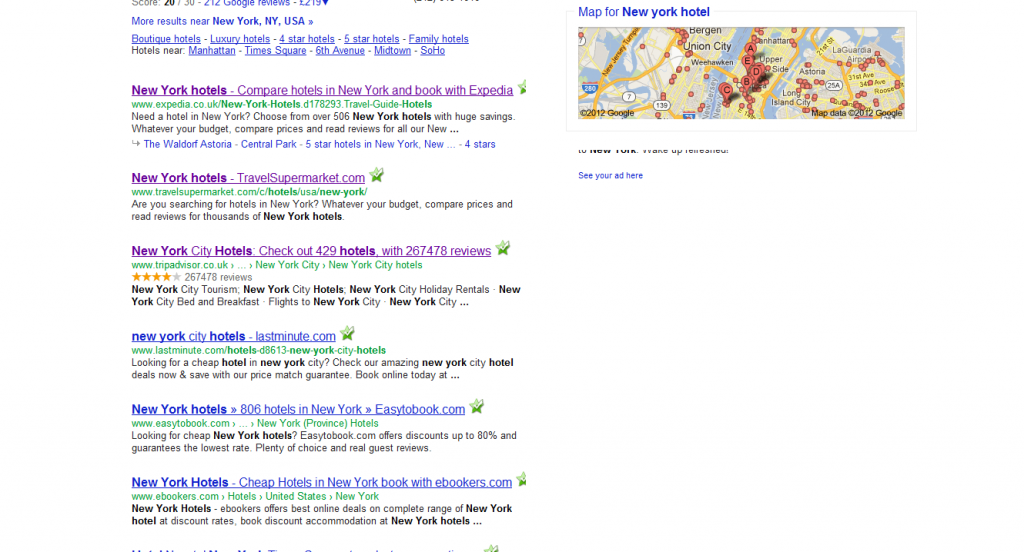
The top three results in this list are:
- Expedia– they offer a listing of many hotels arranged by star classification, how close they are to an airport or a place of interest, brand of hotel, etc.
- Travel Supermarket– They have a page with lots of information about New York, including things to do and places to visit. Handy hints on travel and how to prepare for your trip.
- TripAdvisor– This is another site that offers lots of hotels that people can choose from, they offer a rating system that is done by people who have stayed in the hotels previously.
As you can see, you get different information from each of the top three results for this search – so if you do not find what you are looking for on one site, there’s a good chance you will find it on one of the next two.
What Does This Mean For My Business?
This is a great chance for you to rise above the usual suspects and become an expert in the eyes of Google. By creating content that people find useful, informative and engaging, you will get your information shared around the internet. People on Facebook, Linked-In and Twitter will share the information you provide with other interested groups, which will lead new visitors to your site from places in which you had no marketing before. And if all of your content is of exceptional quality, they will bookmark your website and return regularly.
Now that people are bookmarking, Tweeting, liking and sharing your website all over the internet, Google and the other search engines will realise that you are a person of interest, and they’ll begin to take notice when you speak.
This means that the next time you post new content to your website, the search engines are going to come running to learn what you have to say, and will make the information available to people when they search on that topic. You get listed quicker, more often, in higher positions and once Google trusts your site, you will rank for the competitive terms in your industry – sometimes even above the recognised brand leaders.
This means that you can make more sales, just like you wanted – and Google get to list great content in their results, just like they want.
Comments Off
Business networking, avoid the minefield
If you have ever attended a networking event to help promote your business you may well have felt a little intimidated, in a room with a lot of people you did not know and when you look around they all seem to be chatting to each other quite happily.
I attend a lot of these events and I felt just like that at my first few, but with time, practice and a little preparation it becomes much easier and you can get much more out of the business networking events.
I have read an extremely well written guide on businessballs.com, unfortunately I could not find an author name as I would like to read more by the same contributor.
The article covers many different aspects of the networking environment such as
- The elevator pitch
- How to be helpful and contribute to the group
- How to plan your networking
- Different events you may like to attend
Along with a number of other useful tips. If youthink you may benefit from this article you can read the full thing at http://www.businessballs.com/business-networking.htm
Posted in Uncategorized
Comments Off
10 plus 1 Great marketing advice from Jim Connolly
I have just found an interesting post on jimsmarketingblog.com called top marketing tips and he is not over selling it at all, the marketing information is well worth everyone reading, it does not matter if you are a complete newbie to marketing or an old experienced had it never hurts to read a fresh approach, or to confirm you are doing the right things.
He is extremely keen on both content and email marketing and has a proven track record of success with his own blog generating more than £140,000 in sales last year.
In the article are 11 tips that you are bound to find something useful in, not to spoil the article but he recomends using profesional SEO and marketing people to work with on your website. The full post can be read at http://jimsmarketingblog.com/top-10-marketing-tips/
Comments Off
CHANGES TO THE GOOGLE ALGORITHM – PANDA 3.3
[jwplayer mediaid="403"]
What Is Panda?
- Panda is a learning algorithm that is used to determine the relevance of websites, with regard to their positions in Google’s search engine results. Google first released ‘Panda’ in February 2011, and the algorithm has been steadily evolving ever since.
- When Google’s team manually review a website, they mark it up or down on various positive or negative aspects of the site. In the process, the reviewers are teaching the Panda algorithm to make the same sort of judgements automatically, by showing it what to look at, what to like and what not to like.
- In late February 2012, Google released the latest incarnation of the Panda algorithm – Panda 3.3.
What Does This Mean?
- Link-building has long been a key aspect of the SEO process. Links that were built back to your website are known to serve as a ‘vote of confidence’, indicating that the linking domain trusts and respects your website. This would then prompt Google to elevate your website through the search engine rankings.
- While this is still fundamentally true – link-building is still very important, and can help to increase your rankings – since Panda 3.3, links have been evaluated differently.
- Where previous incarnations of Panda would attribute greater importance to links from high PR websites, Panda 3.3 has switched the focus to relevance. The link to your website must come from a website with the same topic as yours, or it’s not going to count for much.
- Previously successful link-building practices, such as posting on article websites, are now ineffective. The links that these practices are used to build are now viewed as less significant.
How Will This Affect My Website?
- If you have a website that has regularly had links built back to it, you may notice a drop in your Google rankings. Depending on the number of links built to the website, this drop may be severe.
- This does not mean that Google is punishing you. Instead of penalising websites for building irrelevant links, Google is simply discounting all value that those links previously carried.
- In the past, people have made money from ‘auto blogs’ – services that would ‘scrape’ article directories and other websites, change it slightly, and then re-post the content on blogs that were designed to generate advertising revenue. These scraped articles would often include the links back to the site where the original, high-quality article came from. This built up a large number of poor-quality links with lots of anchor text, which boosted a lot of websites in the search results. These are the types of links which have been devalued, and so websites have seen their rankings drop.
- If the SEO benefit of your site relies heavily on high page rank (but contextually irrelevant, in the eyes of Panda 3.3) links, then you may also notice a more substantial drop.
What Can Be Done?
- Link-building is still extremely important, but only if the links built are related to the focus of your website. To improve the SEO of your website, you should be focusing on relevant links, rather than strong links.
- Guest blogging is a solid way of securing links. By offering content to other websites in your field (as a guest author, in exchange for a link back to your website) you ensure that your links are from websites which contain the same industry words and phrases as your own. This demonstrates to Panda that the link is relevant.
- Press releases are, more than ever, a great way of building relevant links. If you have something to report on your business, then announce it! Put together a press release and distribute it among press release websites. Links to your website from a press release about your business are seen as relevant.
What Makes A Good Link?
Good Links:
- Come from pages containing unique content (found nowhere else on the internet)
- Come from websites that relate to the same industry or topic as your website
- Are contextually related to the content on the pages that are linking to you
- Come from pages that contain around 500-1000 words’ worth of content
- Demonstrate that you are an expert in your industry
Bad Links:
- Come from websites that have no contextual link to the topic of your website
- Are crammed into articles and posts that have nothing to do with the topic of your website
- Come from pages that are full of irrelevant links (link farms)
So What’s The Next Step?
- Firstly, don’t panic. It can be disconcerting to see that a website you have carefully built and managed has dropped through the rankings, but it’s not the end of the world. You’re not the only one feeling the effects of the Panda 3.3 update – your competitors are most likely experiencing the same problem as you.
- Trust your SEO company. If they’re on the ball, they’ll already be putting new plans and techniques in place to ensure that your website’s rankings are stabilised as quickly as possible – and working on effective link-building strategies to help you rise through the rankings once again.
- Create engaging content. Put together press releases and send them out; make videos and host them on your website; write interesting articles or blog entries and post them on your site. Give people a reason to come back to your website again and again, and give them a genuine reason to link to you.
- Stay positive. Everyone’s in the same boat since Panda 3.3 – which means that you can be one of the first to start rowing. If you react now, you (or your SEO company) can take advantage of this newly-levelled playing field and work to establish your website as a leader in your field.
Comments Off
SEO Conference
Sean and John will once again be attending LinkLove on the 30th March in London. This one day conference designed for SEO experts, will equip Cravenplan with the latest link building strategies, as well as getting innovative ideas to implement in to our client’s projects, keeping them at the top of the search engines rankings.
John and Sean will also hear from industry leaders on the best new practices for building links with social media and to product pages. What’s more they will find out what outreach tactics actually work which will then be deployed on behalf of our clients.
Posted in Uncategorized
Comments Off
Cravenplan go on the road again: E-Bay for fun and profit.
On the 20th February Cravenplan held their “E-Bay for fun and profit” seminar at Salisbury Playhouse as part of their sponsorship of the play, The Seven Year Itch. This event was held at lunch time and repeated in the evening and welcomed many new faces along, all with varied levels of experience of E-Bay but who were interested in how to get the most out of it.
The seminar looked at the history of E-Bay and how, since it launched in 1995, there are E-Bay sites in 39 countries, making it a widely recognised platform to buy and sell goods. At the same time, areas for caution were explored such as checking feedback to ensure the seller has a good reputation. Similarly when you are selling you should always include the postage and packaging costs in the price, otherwise you may ultimately make a loss and how ending the sale on a Sunday evening can potentially double the amount you receive.
This seminar equipped the delegates with many tips on how to maximise their use of E-Bay whether for personal use or to promote a business and make profit.
For more information about how Cravenplan can help you generate more business through your Web site with their bespoke Web marketing support.
08 March – Digital Photography (lunch or evening) – Salisbury Playhouse
15 March – Digital Photography (lunch or evening)
20 April – Search Engine Optimisation
18 May – What Makes a Web Site Successful? 3hr Workshop
14 June – Using Video on the Web
10 July – E-Bay (lunch or evening
03 August – E-mail Marketing
07 September – Law and the Internet
26 September – Facebook for Businesses 3hr Workshop
11 October – Psychology of the Web
01 November – 101 Ways to Promote your Website
21 November – Conversion Rate Optimisation
06 December – Writing for the Web
Posted in Uncategorized
Comments Off
Cravenplan go on the road: Are there really 101 ways to promote your Web site?
On the 15th February Cravenplan took one of their seminars on the road, the first of five external seminars in 2012. They teamed up with Icon Business Solutions and were the first to host an event at the new Salisbury and South Wilts Sports Club. The seminar was attended by a variety of local businesses all looking for innovative ways to improve and promote their business.
Chris Stanbury managing director of Cravenplan opened the seminar with 101 ways to promote your Web site. These suggestions ranged from straightforward and free recommendations like ensuring all of your staff know your Web site address to the more bizarre and paid forms such as projecting your Web site address with a laser onto a building. The 101 ideas were designed to offer each person five or six to suit their own business model and budget, as well as suggesting methods for measuring success such as QR codes and track-able freephone numbers
Tony Field C.Dir business adviser from Icon Business Solutions, discussed 3 vital steps to grow your business. He explained how if your business is not growing then it is under threat of going under. Tony’s motivational presentation got people thinking about how to make money, reduce working hours and build a successful and committed team. For more information on how Icon Business Solutions can help your business please visit www.iconbusinesssolutions.com.
The two presentations showered the attendees with top tips for taking their business forward, through clever online promotional ideas and improving internal business systems.
For more information about how Cravenplan can help you generate more business through your Web site with their bespoke Web marketing support, contact us
20 February – Digital Photography (evening) – Salisbury Playhouse
08 March – E-Bay (evening) – Salisbury Playhouse
15 March – Digital Photography (lunch or evening)
20 April – Search Engine Optimisation
18 May – What Makes a Web Site Successful? 3hr Workshop
14 June – Using Video on the Web
10 July – E-Bay (lunch or evening
03 August – E-mail Marketing
07 September – Law and the Internet
26 September – Facebook for Businesses 3hr Workshop
11 October – Psychology of the Web
01 November – 101 Ways to Promote your Website
21 November – Conversion Rate Optimisation
06 December – Writing for the Web
Posted in Uncategorized
Comments Off
How trustworthy are your web statistics?
On the 2nd February 2012, Cravenplan held one of their free monthly seminars on Google Analyticsand Web Statistics. The seminar saw a record turn out of 52 delegates from local businesses who were all interested in how may visitors their Web site gets and how to interpret the data.
Most Web site owners run statistic reports, but many don’t actually analyse the results or refer to them. This is not surprising due to the confusing and unreliable nature of the reported statistics and confusion over what they really convey about a Web site. With this in mind some of the terminology was clarified to enable people to understand their reports and maximise their Web site. People often get excited as they have a high number of “hits” on their Web site, unfortunately this is not the same as visitors, it is simply how many files are downloaded from the server which could be by one visitor requesting these files, showing 101 hits when there has only been1 actual page view.
Another challenge faced by Web site owners is the caching of pages, which is where Internet service providers save Web site pages for later viewings in an attempt to save bandwidth. Therefore reducing actual visits to your website as well as retaining out of date information, which in turn is detrimental to your statistics and understanding of who is visiting your web site.
So what do Google Analytics and WebTrends actually tell you?
They both show which files have been requested from the server and at what time. You can also find out which browser has been used to view your web site. However visitors can’t be identified unless your Web site requires a log in, therefore you cannot follow up with them. What’s more the exact number of visitors can’t be obtained due to the issue of caching mentioned earlier. Also, don’t forget your own visits to your Web site. Finally you do not know what search terms didn’t find you, which would be valuable information for search engine optimisation.
Google Analytics vs Logfile analysis (using WebTrends)
Google Analytics is free and uses Java Script but as a result does not give the most reliable interpretation of the statistics, regularly under reporting by 50% therefore not giving the whole picture. Whereas WebTrends use logs which are private and give a more reliable picture of your Web site statistics, however WebTrends figures don’t include cached pages.
You may well be asking yourself what is the point of Google Analytics and WebTrends as you can’t fully rely on them? They are incredibly useful to your business in terms of measuring the effectiveness of your Web site and monitoring the way people use search engines and thus responding to these trends to get more business through your Web site.
For more information on how Cravenplan can help you increase business through your Web site, with their bespoke web marketing support, contact us
15 February – Refocus your Business for 2012 (5:30pm) – Salisbury and South Wilts Sports Club
20 February – Digital Photography (lunch or evening) – Salisbury Playhouse
08 March – E-Bay (lunch or evening) – Salisbury Playhouse
15 March – Digital Photography (lunch or evening)
20 April – Search Engine Optimisation
18 May – What Makes a Web Site Successful? 3hr Workshop
14 June – Using Video on the Web
10 July – E-Bay (lunch or evening
03 August – E-mail Marketing
07 September – Law and the Internet
26 September – Facebook for Businesses 3hr Workshop
11 October – Psychology of the Web
01 November – 101 Ways to Promote your Web site
21 November – Conversion Rate Optimisation
06 December – Writing for the Web
Posted in Uncategorized
Comments Off
How to choose an SEO company to work with
As the SEO industry continues to expand, and more and more businesses wise up to the fact that website optimisation is a crucial aspect of marketing, more and more SEO agencies are springing up all over the world.
Choosing the most capable, the most suitable and the most cost-effective company to promote your business can therefore be a tricky business; particularly as web optimisation is a relatively new industry. Too many business owners are falling prey to false promises and quick fixes from black-hat SEO companies – so here are a few tips on selecting the agency that’s right for you.
Step One – Identifying Potential Candidates
It’s best to start your search locally, for a number of reasons.
- Firstly, using a search engine to look for SEO agencies in your area will throw up a few likely possibilities – if the agency in question have managed to manoeuvre themselves into the top spot of Google for a phrase like ‘Search Engine Optimisation London’, for example, or even ‘Search Engine Optimisation UK‘, then chances are that they have the necessary skills to engineer similar successes for your business.
- Another reason to keep it local, or at the very least within your country, is ease of communication. SEO work can often spill over into web design territory, so engaging the services of a cheap India-based SEO firm, for instance, may well leave you struggling to communicate to the SEO staff what it is that you need – on account of either the language barrier, or the fact that conflicting time zones can make foreign operatives difficult to get hold of.
- Once you’ve identified an agency that you might be interested in working with, start asking around! Word of mouth is an often-overlooked way to gauge an SEO company’s reputation, so take full advantage of it.
Step Two – Are They Legit?
Once you’ve set your sights on an SEO agency, it’s time to make sure that they’re as good as they seem. Visit their website, and see how they measure up when it comes to these factors.
- As mentioned above, come up with some keywords and phrases that you expect the agency would rank for, and search for them in Google. If they don’t rank well for them, it’s not a good sign. If they’re not putting effort into their own SEO campaigns, there’s no guarantee that they’ll put any more work into yours.
- Read up on the company history. The best SEO companies will have been in business for a long time, and will have plenty of experience in the industry. Steer clear of businesses only a year old – you should always consider a firm’s track record before investing in their services, and if they don’t have one, you’re better off hanging onto your money.
- Is SEO their primary concern as a business? In light of the expanding industry, countless web design companies and software specialists have tacked on ‘SEO Experts’ to their company repertoire. In reality, however, these agences often have as much experience in the SEO field as you do in web design. Be sure to choose a company that specialises in SEO, to ensure that your campaign is handled by someone who knows what they’re doing!
- Have a look at the sort of clients the agency works with, or has worked with in the past – most websites will include a portfolio or selection of case studies. Take a look at these clients’ websites, and see how highly they rank in the search engines, for a variety of keywords related to their industry. For the best indication of how well the SEO company have served their clients in the past, however, you can pick up the phone and ask the clients themselves.
- You should also take a look at the agency’s average client lifespan. If their clients have all ended their association with the SEO company after nine months, it doesn’t bode well for you as a potential new client. The ideal SEO agency will have an average client lifespan of at least 2-3 years.
- If the website contains details of the agency’s workforce, have a look at the number of staff they employ. You don’t want to be hiring a one-man-band – there’s always a danger that their SEO business is merely a sideline, alongside a full-time job. Such consultants simply do not have the free time necessary to manage your business’ SEO campaign effectively. If the website doesn’t mention its workforce, be sure to enquire about the company’s size if and when you decide to contact them.
- Ask yourself if you have any interest in a social media campaign – spreading awareness of your brand or services via websites like Facebook, LinkedIn, Twitter, and so on. If this interests you, then take a look at the SEO agency’s own presence on these websites. If they don’t have profiles on social media sites, or if they just have a token Facebook page which doesn’t seem to be kept up-to-date, then chances are they’re not going to be much help with your social media plans.
Step Three – The Final Hurdle
So they rank well for their keywords, their website seems up to scratch and their clients speak highly of them. It’s time to get in touch with the agency, and ask them a few final questions.
- What are the terms of your contract?It’s important, before you sign anything, to know exactly what you’re signing. You should always ask this, therefore, to make sure you know precisely what you’re signing up for. Find out if contracts cover a fixed period of time, or if they’re ongoing, on a monthly basis. Also enquire as to the notice they would require in order for you to change or terminate your contract. Be wary of fixed-term contracts – many unscrupulous SEO companies will utilise black-hat techniques to generate quick results, to lure you into signing up long-term. These techniques are neither reliable nor ethical, however, and in some cases may even result in a search engine penalising you for using them. If you’re locked into a fixed-term contract, you’ll have no choice but to continue paying the agency regardless.
- How involved with the process can I be?Although attempting to micro-manage your SEO company is obviously counter-productive, you need to be sure that the agency will listen to you, should you wish to raise any issues, concerns or suggestions regarding the SEO work. Negotiating a monthly report can help ensure that you are kept up to speed on the work as it is carried out, and allows you regular contact with the agency. This is also a good point to assess the agency’s flexibility regarding the SEO process – if they have a fixed routine that they follow for each new client and are unwilling to try new techniques and strategies, it might be better to look elsewhere. SEO is such a fluid industry that the idea SEO agency has to be equally flexible and innovative.
- Can we meet at your premises?Holding a meeting at the agency’s offices allows you to see first-hand the environment in which your work will be carried out, and helps you to gauge how serious the company is about their work as an SEO agency. If you find yourself in a dingy bedroom at the back of somebody’s house, or looking at a room full of clueless or unmotivated staff, again, it would be better to find an agency more dedicated to the task.
- Have you worked with companies in my industry (or a related industry) before?Ask if they have any figures from work they might have carried out for a company in your area of business. For one thing this will demonstrate that they have experience in working for businesses like yours, and for another, it may give you an indication of the level of improvement you can expect.
- Do you outsource any of the work you do for your clients?This is a bit of a judgement call; there’s no definitive good or bad answer either way. On one hand, outsourcing work will dilute the level of control you have over that particular project, but on the other, outsourcing work allows your SEO agency to pursue other, potentially more effective, web marketing strategies that their in-house staff may not possess the necessary skills to carry out.
- How will determine the best keywords for my business?The answer you’re looking for here is ‘keyword research, and discussion with you, the client.’ There are SEO companies who claim to charge a relatively small fee in exchange for getting your website to rank at position 1 in the search engines for a phrase or phrases of your choosing. This might sound too good to be true, and it is. These companies will often use black-hat techniques, as previously mentioned, to get quick results, and the terms and conditions will usually lock you into a long-term contract. The best SEO companies will research the industry in which you operate, and draw up a short-list of suggested keywords, based on the amount of monthly searches and the degree of competition for each. The agency will then discuss the list with you, gradually refining it until both parties are happy with the selection of keywords.
- Can you give me an idea of the work you will carry out in the first few months of my contract with you?Again, this is a judgement call. A typical SEO campaign will begin with streamlining of the website itself – tweaking the on-page text, the meta data and the layout, to ensure that the pre-agreed keywords are prominently displayed to the search engines. A major part of any SEO campaign is building links back to the website. If the agency’s 3-month plan runs along these lines, it’s a good sign that they know what they’re doing.
Posted in Uncategorized
Comments Off